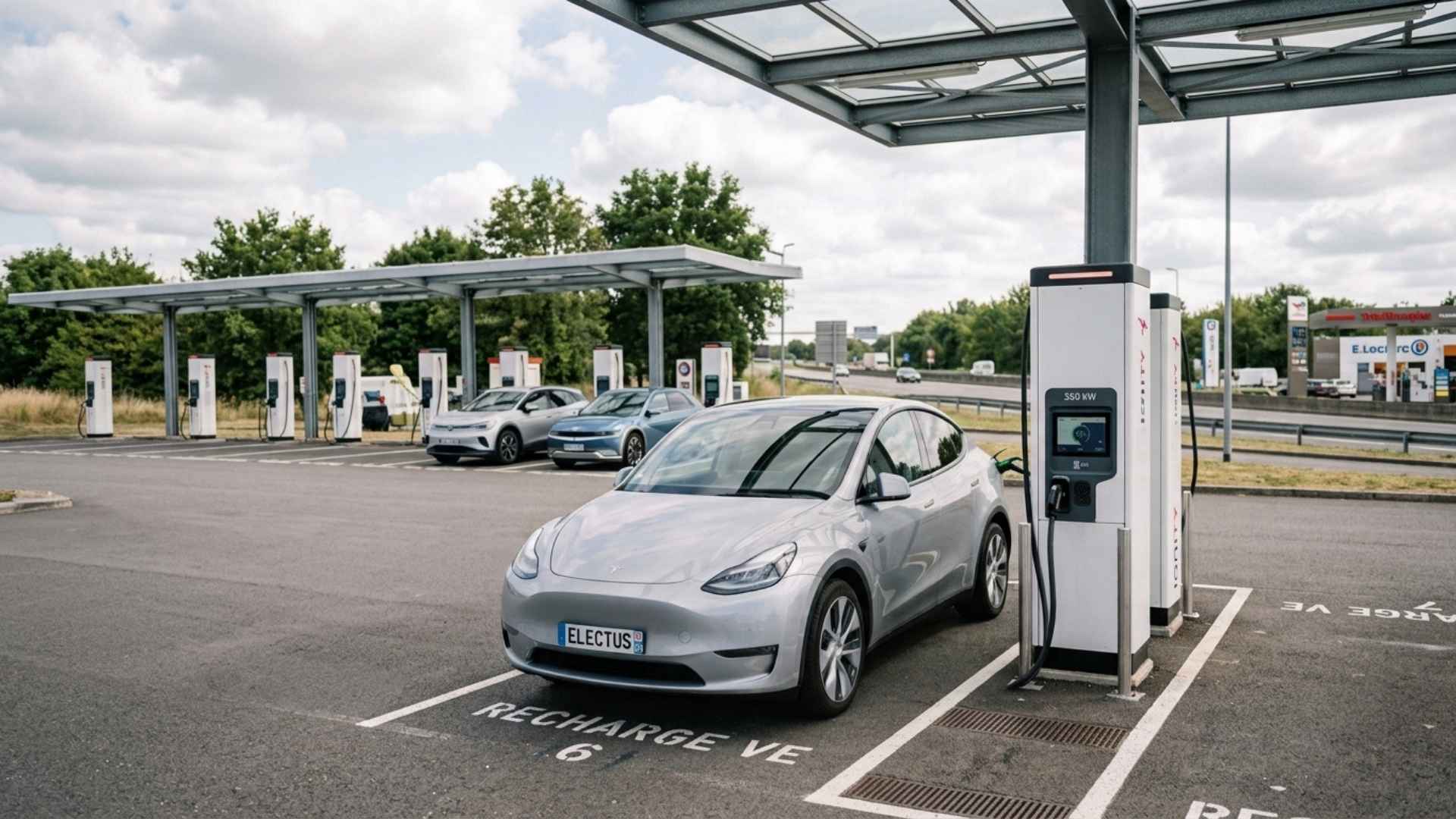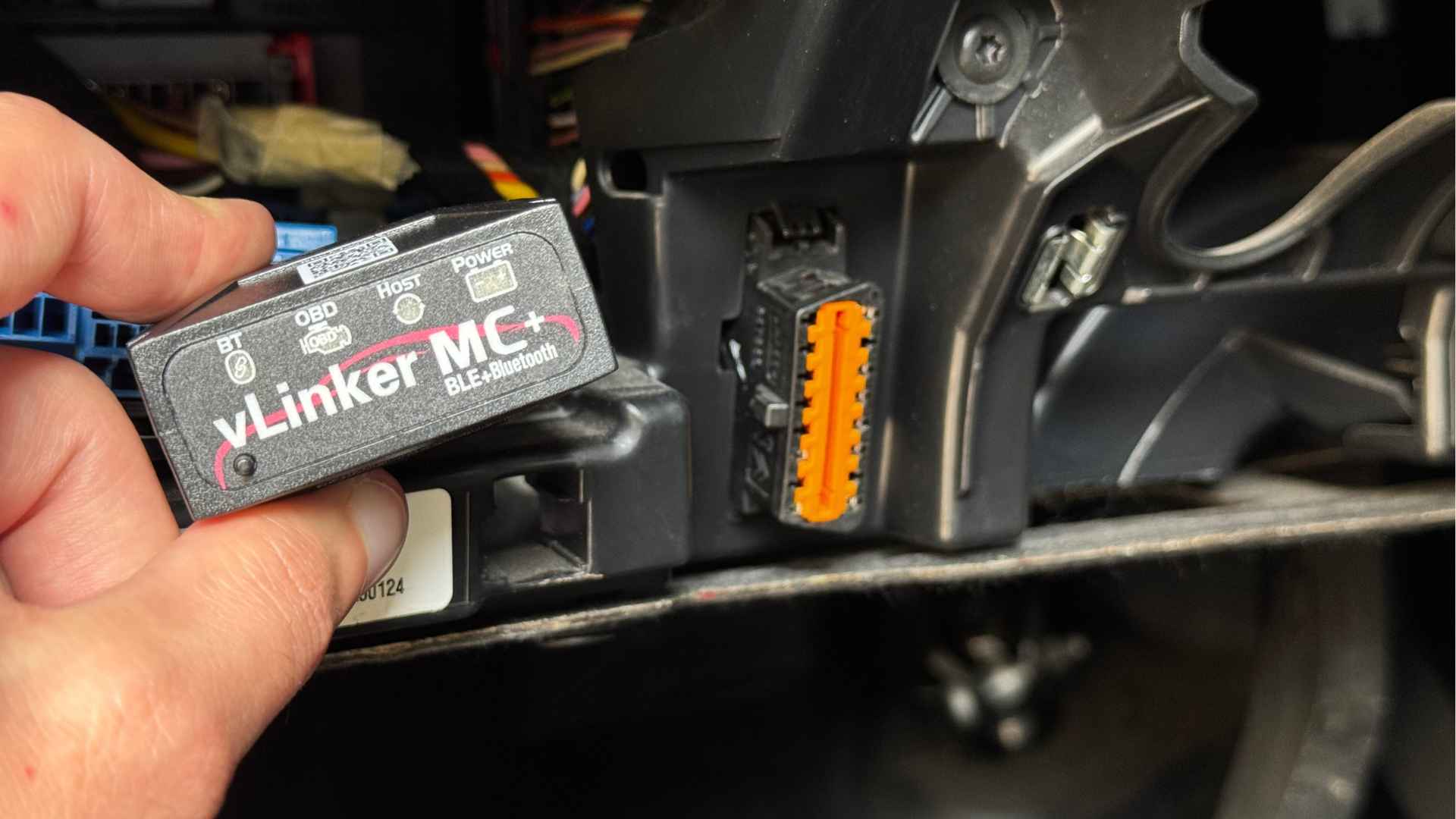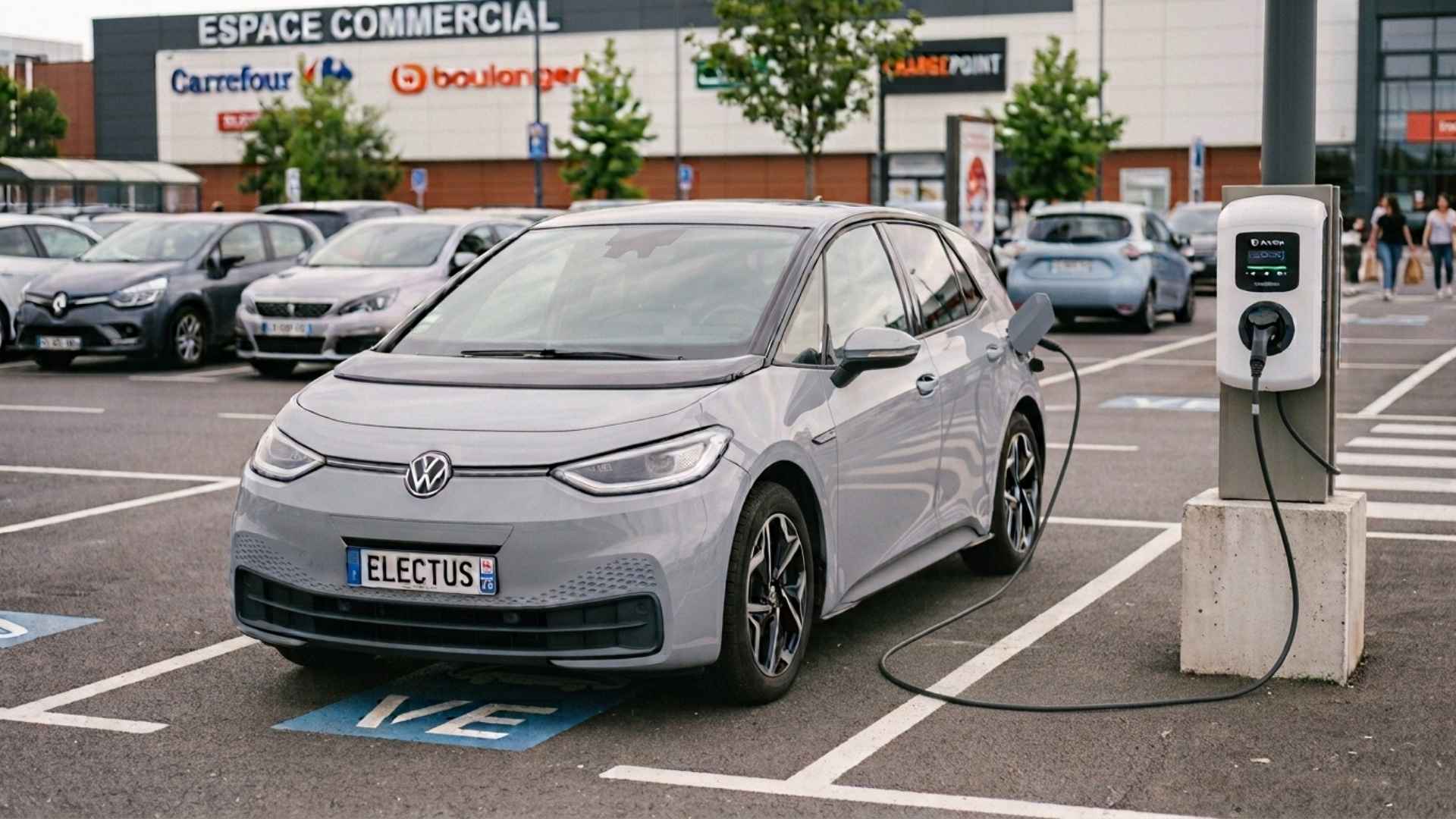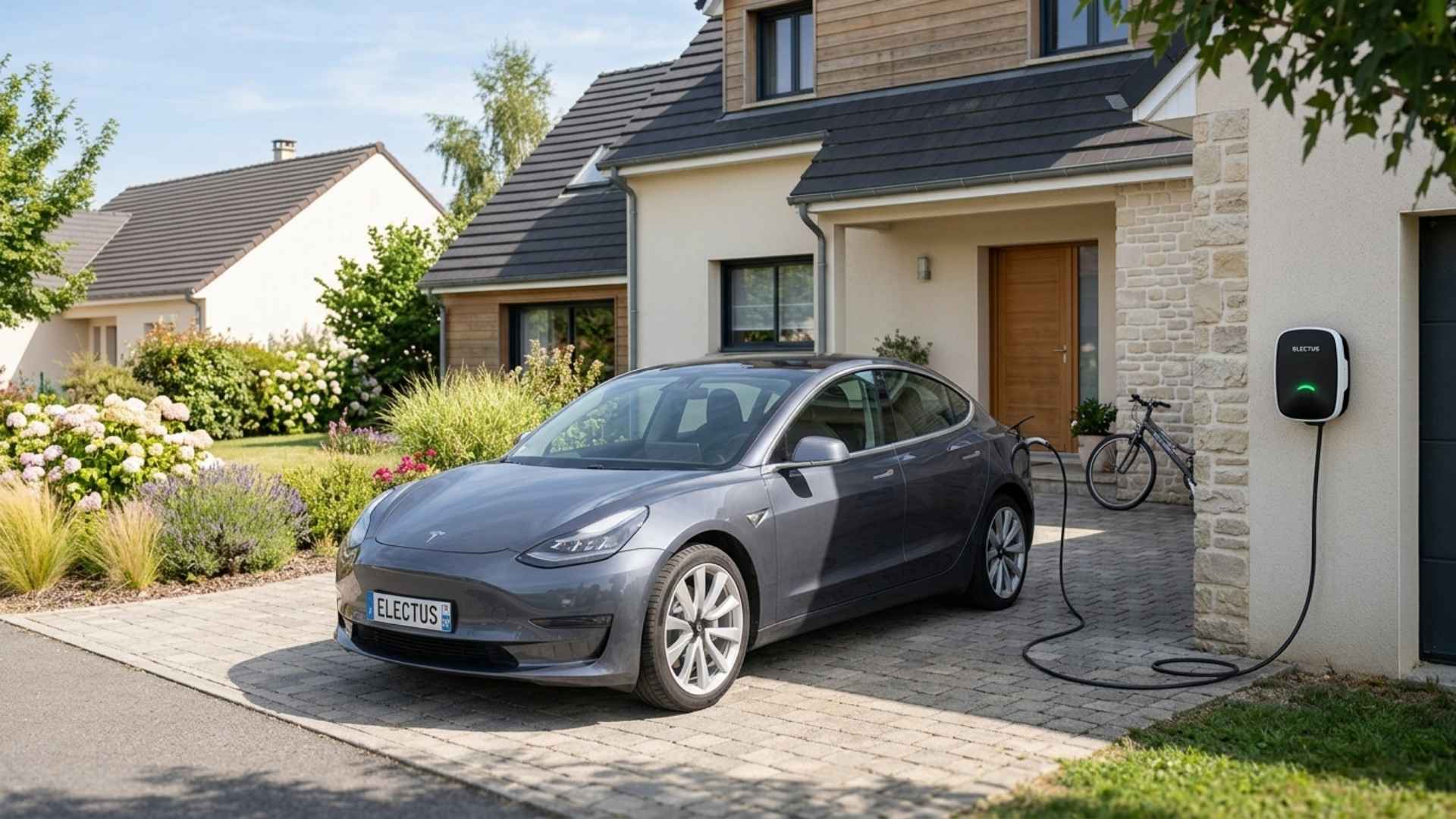
If your car can be parked on your property, in a garage, or in a spot with access to electricity, charging at home is generally the most convenient solution.
The car can be plugged in overnight and recover the energy used during the day. In most cases, you won’t need to fully recharge the battery after every trip.
The choice of equipment mainly depends on:
- The number of kilometers driven each day
- How long the car can stay plugged in
- Your electrical installation
- Your electricity plan
- The power your vehicle can accept
Can you charge an electric car on a standard household outlet?
An electric car can be plugged into a standard household outlet, provided that the electrical installation is in good condition and properly rated.
This solution mainly suits drivers who cover few kilometers each day. Its power is generally limited to around 1.8 to 2.2 kW.
Depending on the car’s consumption, a household outlet typically delivers about 10 to 15 km of range per hour of charging.
An eight-hour night can therefore be enough to recover the range used during a typical day of driving.
Before regularly using an existing outlet, it’s recommended to have its condition and wiring checked by a professional.
Using a reinforced Green’Up outlet
The Green’Up outlet looks like a standard electrical outlet, but it’s designed to handle more intensive and longer charging sessions.
When paired with a compatible cable, it can deliver up to around 3.7 kW. This allows for faster charging than a standard household outlet, without needing to install a wall-mounted charging station.
It’s a good intermediate solution when:
- The household outlet is too slow
- You cover a moderate daily distance
- Your car stays plugged in for several hours
- You don’t want to install a charging station
The outlet must be installed on a properly rated circuit with the necessary electrical protections.
Which cable should you use with a household outlet?
To charge from a household outlet or a Green’Up outlet, you’ll need an occasional charging cable.
It typically includes:
- A Schuko plug on the outlet side
- A Type 2 connector on the vehicle side
- A control box responsible for securing the charging session
To get the most out of a Green’Up outlet, check that your occasional charging cable can handle a current of 16 A. This information is usually printed on the back of its control box.
If your vehicle doesn’t come with a suitable cable, you can order a compatible one.
Should you install a home charging station?
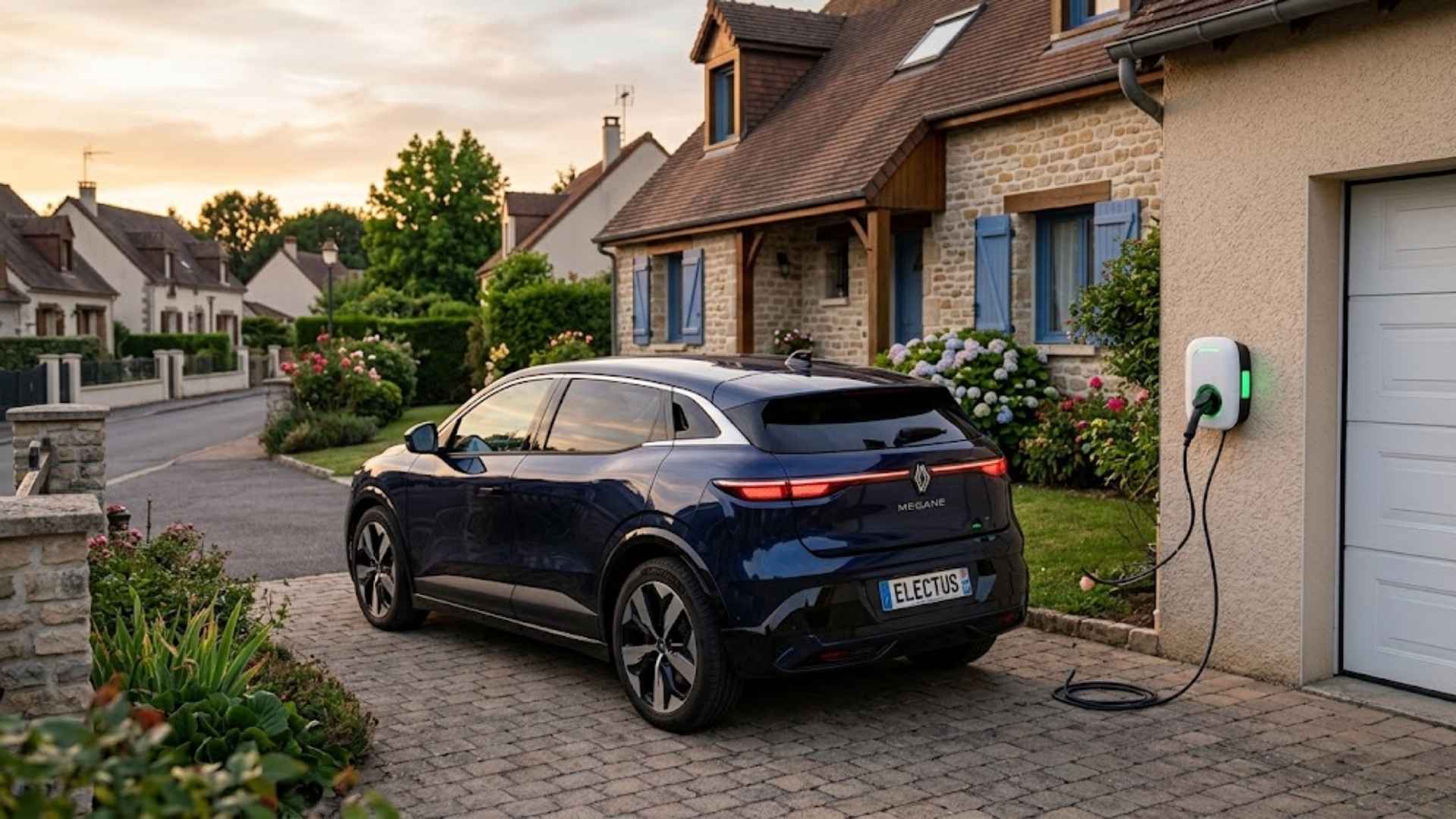
When a household outlet or a Green’Up outlet doesn’t provide enough range, you can install a home charging station, also known as a wallbox.
This installation is more expensive, but it brings several advantages:
- Faster charging
- An installation designed for regular use
- Scheduling during off-peak hours
- Monitoring of electricity consumption
- Adjustment to the power available in your home
- An attached cable on certain models
A charging station is particularly worthwhile if you drive a lot of kilometers, or if several electric vehicles need to be charged.
What power should you choose for a home charging station?
The choice depends on your electrical installation and your vehicle’s onboard charger.
In a home with a single-phase supply, a 7.4 kW charging station is generally the best compromise.
With a three-phase installation, an 11 kW station can be considered, provided that the vehicle can accept this power level.
| Solution | Typical power | Range recovered per hour |
|---|---|---|
| Household outlet | 1.8 to 2.2 kW | About 10 to 15 km |
| Green’Up outlet | Up to 3.7 kW | About 20 to 30 km |
| Home charging station | 7.4 kW | About 35 to 50 km |
| Three-phase station | 11 kW | About 55 to 75 km |
These estimates vary depending on the vehicle’s consumption and charging losses.
The amount actually recovered is also limited by the battery’s capacity. A car will naturally stop charging once the battery is full.
Can the car limit the charging power?
The power announced by the charging station doesn’t always match the power actually received by the vehicle.
Every electric car has an onboard charger responsible for converting the alternating current supplied by the outlet or station.
Its maximum power can be:
- 3.7 kW
- 7.4 kW
- 11 kW
- More rarely, 22 kW
A vehicle limited to 7.4 kW won’t charge at 11 kW simply because it’s plugged into a more powerful station.
Check your vehicle’s profile on the Electus app or website to find out its maximum AC charging power.
Is a 22 kW charging station useful at home?
Installing a 22 kW charging station is rarely genuinely worthwhile in a home.
It generally requires:
- A three-phase electrical installation
- A significant subscribed power capacity
- Properly rated wiring
- A vehicle capable of accepting 22 kW in AC
Few electric vehicles accept this power level. For most drivers, a 7.4 or 11 kW charging station is already enough to recover sufficient range overnight.
A 22 kW station can still make sense for a compatible vehicle that needs to be charged quickly, several times in the same day.
How long does it take to charge at home?
Charging time depends on the amount of energy to recover, not just the battery’s total capacity.
To recover about 40 kWh:
| Solution | Approximate charging time |
|---|---|
| Household outlet at 2.3 kW | About 18 hours |
| Green’Up outlet at 3.7 kW | About 11 hours |
| Charging station at 7.4 kW | About 5 h 30 |
| Charging station at 11 kW | About 3 h 45 |
In practice, you’ll often only need to recover the energy used during the day. The required plug-in time will therefore be shorter.
Scheduling charging during off-peak hours
Many cars and charging stations let you schedule when charging starts.
You can plug in your vehicle as soon as you get home while having the charging session start automatically during off-peak hours.
This scheduling allows you to:
- Reduce the cost of charging
- Limit consumption during peak demand hours
- Have a sufficiently charged battery the next morning
Some charging stations can also adjust their power based on your home’s overall consumption. This feature prevents exceeding your subscribed power capacity when several appliances are running at the same time.
What if you can’t charge at home?
Not every household has access to electricity at their parking spot: a shared building without dedicated infrastructure, a home without a garage, on-street parking… In these situations, charging at home simply isn’t an option.
That doesn’t mean giving up on electric driving. The solution is to rely on the public charging network, organizing around regular charging sessions rather than a daily charge at home: at work, along your usual routes, or at nearby stations.
The Electus app helps you locate available charging stations around you and start a session in just a few seconds, wherever you are.
Which solution should you choose to charge at home?
A household outlet may be enough if you drive few kilometers and your car stays plugged in for a long time.
A Green’Up outlet lets you recover more range without installing a charging station.
A 7.4 kW charging station suits most homes and drivers.
An 11 kW charging station is mainly worthwhile with a three-phase installation and a compatible vehicle.
The best setup isn’t necessarily the most powerful one. It should match your daily mileage, your vehicle, and your electrical installation.
 Charging
Discover the different charging options: at home, on public AC chargers, or on DC fast chargers.
Read the article