80% or 100%? It’s one of the first questions people ask when switching to electric, and the advice out there often contradicts itself. Some insist you should never go above 80%, while others charge to 100% every night without any trouble. In reality, both are right… depending on their car.
The right answer depends on two things: your battery technology (LFP or NMC) and the trip you’re planning (daily driving or a road trip). To make sense of it, let’s first look at where this famous 80% rule comes from.
Why does everyone talk about 80%?
There are actually two different reasons behind this number, and they shouldn’t be confused.
The first is about battery health. A lithium-ion battery ages faster when it stays at a high state of charge for a long time, especially in hot weather: its cells are then at maximum voltage, which speeds up wear. The key word here is “stays”: charging to 100% doesn’t wear out the battery by itself, it’s the time spent at that level that matters.
The second is about charging speed. On a fast charger, power drops sharply above 80%: the last few percent take much longer than the first ones.
These two reasons don’t affect every battery in the same way, and that’s where battery chemistry comes in.
LFP or NMC: the first question to ask
Most electric cars use one of these two technologies:
- NMC (nickel manganese cobalt): denser, it offers more range, but it is more sensitive to high states of charge.
- LFP (lithium iron phosphate): tougher, it handles being charged to 100% very well. It even needs it regularly: its voltage barely changes between 20 and 90%, so the car uses a full charge to recalibrate its gauge and display an accurate percentage.
To find out which technology your battery uses, check your vehicle’s page in the Electus app or the manufacturer’s manual.
 Car
LFP or NMC battery? Lifespan, range, cold, charging to 100% and price: compare both technologies and choose your electric car with confidence.
Read the articleHere’s the quick answer for each situation:
| Daily driving | Road trip | |
|---|---|---|
| NMC battery | 80% | 100% at departure, then about 80% on fast chargers |
| LFP battery | 100% | 100% at departure, then about 80% on fast chargers |
This table gives the general idea. Let’s now go into detail, starting with the most common use: daily driving.
Daily driving: look after your battery
In everyday life, most trips are short and charging happens at home or at work. You rarely need your car’s full range, and that’s exactly what lets you go easy on the battery.
NMC battery: 80%
With an NMC battery, set your everyday charge to 80%. This level easily covers your usual trips, while sparing the battery from sitting for hours, or even days, at full charge.
Keep 100% charging for times when you really need all your range, such as before a road trip. What you should avoid is leaving the car parked for several days at 100%.
LFP battery: 100% with no worries
With an LFP battery, you can charge to 100% every day. Many manufacturers even recommend it at least once a week to keep the gauge accurate. If you always stop at 80%, the car may end up showing an approximate range.
The only precaution: avoid leaving the car unused for several weeks at 100%.
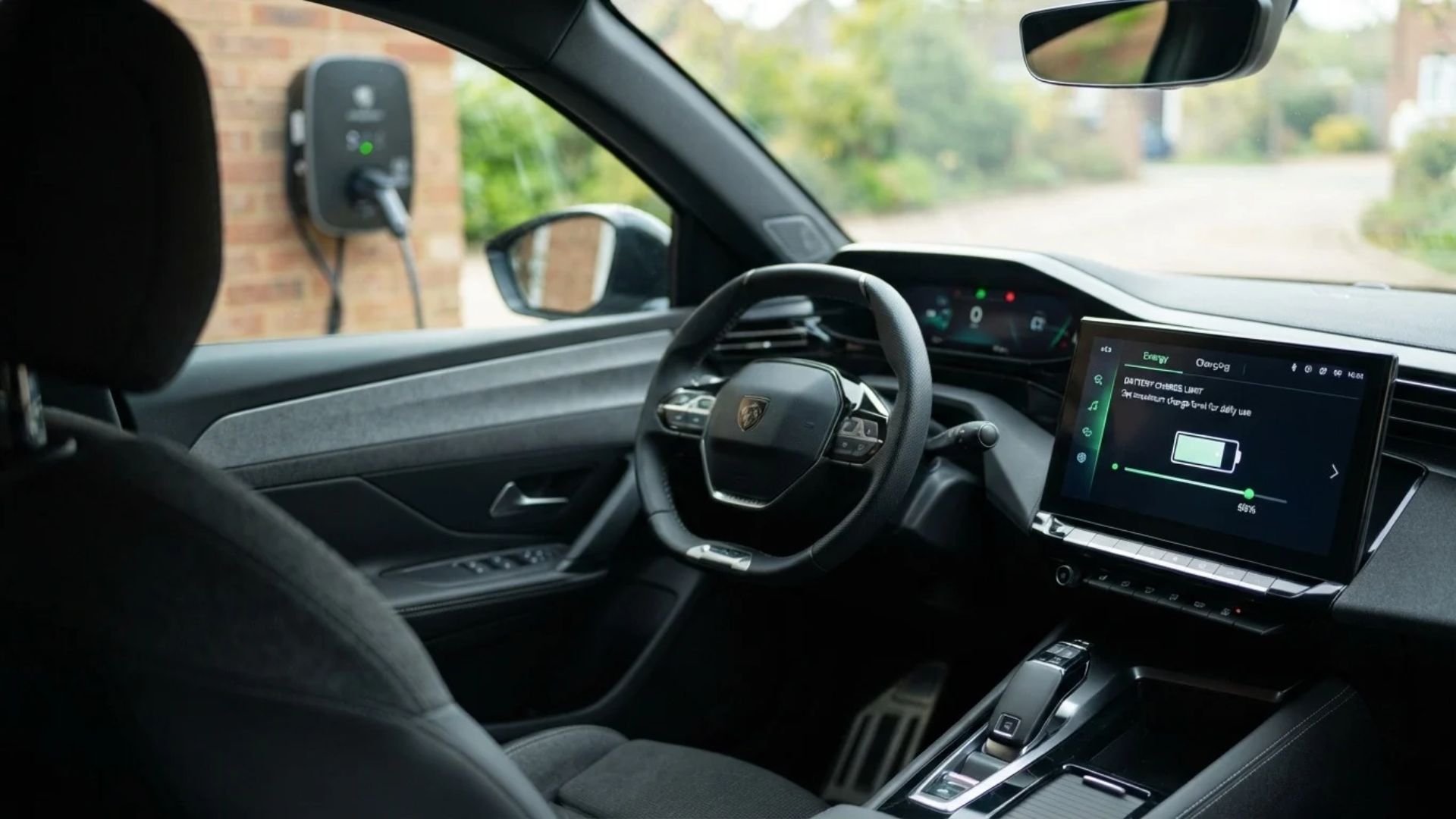
Tip: most cars let you set a charge limit from the central screen or the manufacturer’s app. Set it once to the right level for your battery, and charging will stop on its own at the right moment, whether at home or at a public charger.
For daily driving, the main concern is battery health. On a road trip, another constraint takes over: the time spent at the charger.
Road trips: leave full, charge smart
At departure: 100%, whatever the battery
For a long trip, set off with a battery charged to 100%, whether your car has an LFP or NMC battery. Every kilometre of range gained at departure means one fewer charging stop, or a later one.
With an NMC battery, staying at 100% for a few hours before leaving is not a problem. A full charge the evening before for a departure the next morning is therefore perfect. What you should avoid is staying at full charge for several days.
On a fast charger: stop at around 80%
To understand why charging slows down at the end, picture a theatre filling up. When the doors open, every seat is free: people stream in and sit down without searching. But when the theatre is almost full, each latecomer has to walk along the rows to find one of the last empty seats, and getting everyone in slows down.
A battery works the same way. When it’s almost empty, the energy easily finds its place and the car accepts high power. As it approaches full, the “free seats” become scarce and the car reduces power to protect its cells.
The result: going from 10 to 80% often takes 20 to 30 minutes, while the last 20% can take almost as long on their own. On a road trip, several short stops up to 80% are therefore usually quicker than one long stop up to 100%.
It’s still better to charge higher in some cases: when the next charger is far away, when chargers are scarce along your route, or when you’re not sure the next one will be available.
One nuance for LFP batteries: their charging often stays steadier up to a high level, but it also slows down at the end and becomes noticeably slower in cold weather. Remember to turn on battery preconditioning before reaching the charger, if your car offers it.
 Charging
How to use a fast charger on the motorway? Plugging in, payment, charging time and tips for long road trips in your electric car.
Read the articleTip: the Electus planner calculates your charging stops and your battery percentage on arrival. With Electus Premium, it tracks your battery’s actual level through your car account or an OBD dongle, and adjusts the arrival percentage if your consumption changes along the way.
Stopping at 80% also means knowing how low you can go before plugging in again.
And at the bottom of the gauge, how low can you go?
Ideally, keep a 10 to 20% buffer. It gives you room to handle the unexpected: a busy or out-of-service charger, a detour, higher consumption in cold weather. Just like with a full charge, it’s also better to avoid leaving the car parked for a long time almost empty.
On a road trip, arriving at a fast charger at around 10 to 15% is actually ideal: that’s when the “theatre” is empty and charging is at its fastest. The 10 → 80% window is the one that saves you the most time.
These guidelines cover most situations, but a few cases fall outside them.
Special cases
- Car parked for a long time (holidays, business trip): leave the battery at around 50%, whether it’s LFP or NMC.
- Very cold weather: range drops in winter, which is a good reason to set off with a bit more charge. Charging just before leaving also lets you benefit from a battery that’s already warm and performs better.
- Public accelerated charger: charging also slows down towards the end. Some operators also charge for occupancy time, which makes the last few percent expensive and ties up the charger for other drivers.
- Manufacturer recommendations: they always come first. Some cars already keep a hidden reserve: the 100% displayed is then not quite the battery’s actual 100%.
In summary
- NMC battery for daily driving: charge to 80%.
- LFP battery for daily driving: charge to 100%, at least once a week to keep the gauge accurate.
- At the start of a road trip: 100% for both technologies. Charging the evening before works perfectly for an NMC.
- On a fast charger: stop at around 80%, unless the next charger is far away or uncertain.
- At the bottom of the gauge: keep a 10 to 20% buffer, and arrive at a fast charger at around 10 to 15% to charge faster.
- Car parked for a long time: leave it at around 50%.
With these guidelines, you charge to the right level for every situation and look after your battery with peace of mind.